How to Read a Http Reply in Html?
Read Time: 21 mins Languages:
Whether yous're a programmer or not, you have seen it everywhere on the web. Even your beginning Hello World PHP script sent HTTP headers without you realizing it. In this article, we are going to learn near the basics of HTTP headers and how we tin can use them in our spider web applications.
What Are HTTP Headers?
HTTP stands for "Hypertext Transfer Protocol". The entire World wide web uses this protocol. It was established in the early 1990s. Almost everything y'all see in your browser is transmitted to your reckoner over HTTP. For instance, when you opened this article folio, your browser probably sent over 40 HTTP requests and received HTTP responses for each.
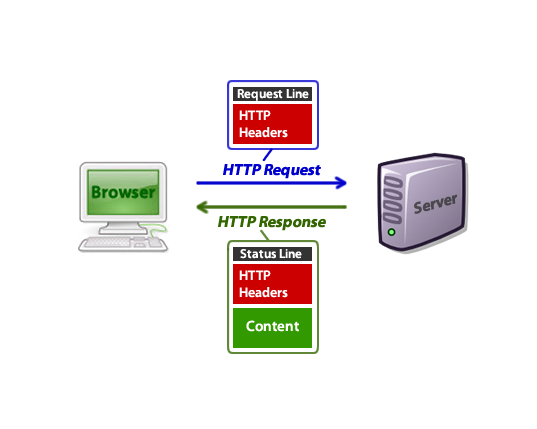
HTTP headers are the core part of these HTTP requests and responses, and they acquit information virtually the customer browser, the requested folio, the server, and more.

Example
When you lot type a URL in your address bar, your browser sends an HTTP asking, and it may await like this:
GET /tutorials/other/top-20-mysql-best-practices/ HTTP/1.1 Host: code.tutsplus.com User-Amanuensis: Mozilla/5.0 (Windows; U; Windows NT 6.1; en-United states; rv:1.9.1.5) Gecko/20091102 Firefox/three.5.5 (.NET CLR 3.five.30729) Accept: text/html,application/xhtml+xml,application/xml;q=0.nine,*/*;q=0.8 Have-Linguistic communication: en-us,en;q=0.five Take-Encoding: gzip,deflate Accept-Charset: ISO-8859-one,utf-8;q=0.7,*;q=0.vii Keep-Live: 300 Connection: proceed-alive Cookie: PHPSESSID=r2t5uvjq435r4q7ib3vtdjq120 Pragma: no-cache Cache-Control: no-cache
The first line is the "Request Line", which contains some basic information on the asking. And the rest are the HTTP headers.
After that request, your browser receives an HTTP response that may look similar this:
HTTP/ane.x 200 OK Transfer-Encoding: chunked Date: Sat, 28 Nov 2009 04:36:25 GMT Server: LiteSpeed Connection: close X-Powered-Past: W3 Total Cache/0.8 Pragma: public Expires: Sat, 28 November 2009 05:36:25 GMT Etag: "pub1259380237;gz" Cache-Control: max-age=3600, public Content-Blazon: text/html; charset=UTF-8 Concluding-Modified: Sabbatum, 28 November 2009 03:50:37 GMT Ten-Pingback: https://code.tutsplus.com/xmlrpc.php Content-Encoding: gzip Vary: Accept-Encoding, Cookie, User-Agent <!DOCTYPE html PUBLIC "-//W3C//DTD XHTML one.0 Strict//EN" "https://world wide web.w3.org/TR/xhtml1/DTD/xhtml1-strict.dtd"> <html xmlns="http://www.w3.org/1999/xhtml"> <head> <meta http-equiv="Content-Blazon" content="text/html; charset=utf-eight" /> <title>Top xx+ MySQL All-time Practices - Nettuts+</title> <!-- ... residue of the html ... -->
The first line is the "Status Line", followed past "HTTP Headers", until the blank line. After that, the "content" starts (in this case, the HTML output).
When you lot look at the source code of a spider web page in your browser, you will only run across the HTML portion and non the HTTP headers, even though they actually have been transmitted together, as you tin run across in a higher place.
These HTTP requests are likewise sent and received for other things, such as images, CSS files, JavaScript files, etc. That'southward why I said before that your browser sent at to the lowest degree 40 or more HTTP requests every bit you loaded just this article page.
Now, let'due south starting time reviewing the structure in more than particular.
How to See HTTP Headers
I used Firefox Firebug to analyze HTTP headers, but you lot tin use the Programmer Tools in Firefox, Chrome, or any modern web browser to view HTTP headers.
In PHP:
-
getallheaders()gets the request headers. You tin as well apply the$_SERVERassortment. -
headers_list()gets the response headers.
Farther in the article, nosotros volition see some code examples in PHP.
HTTP Asking Construction

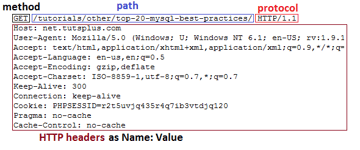
The first line of the HTTP request is called the asking line and consists of iii parts:
- The "method" indicates what kind of request this is. The virtually common methods are Get, POST, and Caput.
- The "path" is generally the function of the URL that comes after the host (domain). For case, when requesting "https://code.tutsplus.com/tutorials/tiptop-twenty-mysql-best-practices--net-7855" , the path portion is "/tutorials/peak-twenty-mysql-best-practices--cyberspace-7855".
- The
protocolpart containsHTTPand the version, which is usually ane.ane in modern browsers.
The remainder of the request contains HTTP headers every bitProper noun: Value pairs on each line. These contain various information most the HTTP request and your browser. For instance, theUser-Agent line provides information on the browser version and the Operating Arrangement you are using.Accept-Encoding tells the server if your browser can take compressed output like gzip.
You may have noticed that the cookie data is besides transmitted inside an HTTP header. And if in that location was a referring URL, that would have been in the header also.
Nearly of these headers are optional. This HTTP asking could have been as small as this:
GET /tutorials/other/top-20-mysql-best-practices/ HTTP/1.one Host: code.tutsplus.com
And you would still become a valid response from the spider web server.
Asking Methods
The 3 near ordinarily used request methods are Become, Postal service, and Caput. You're probably already familiar with the kickoff 2 from writing HTML forms.
Become: Retrieve a Document
This is the master method used for retrieving HTML, images, JavaScript, CSS, etc. Most information that loads in your browser was requested using this method.
For example, when loading an Envato Tuts+ article, the very showtime line of the HTTP request looks like so:
GET /tutorials/other/elevation-20-mysql-all-time-practices/ HTTP/1.1 ...
Once the HTML loads, the browser will start sending GET requests for images that may wait like this:
GET /wp-content/themes/tuts_theme/images/header_bg_tall.png HTTP/ane.one ...
Web forms tin be set to utilize the GET method. Here's an example.
<form method="GET" action="foo.php"> Showtime Proper name: <input type="text" name="first_name" /> <br /> Last Name: <input type="text" name="last_name" /> <br /> <input type="submit" proper name="action" value="Submit" /> </form>
When that form is submitted, the HTTP request begins like this:
Go /foo.php?first_name=John&last_name=Doe&action=Submit HTTP/1.i ...
You can run into that each class input was added to the query string.
POST: Ship Information to the Server
Even though y'all can send data to the server using GET and the query cord, in many cases Mail volition be preferable. Sending big amounts of information using GET is not practical and has limitations.
Mail requests are most unremarkably sent by web forms. Permit's change the previous class instance to a Postal service method.
<form method="POST" action="foo.php"> First Name: <input type="text" name="first_name" /> <br /> Final Name: <input blazon="text" name="last_name" /> <br /> <input type="submit" proper noun="activity" value="Submit" /> </form>
Submitting that class creates an HTTP request like this:
Postal service /foo.php HTTP/1.1 Host: localhost User-Agent: Mozilla/five.0 (Windows; U; Windows NT half dozen.1; en-US; rv:1.9.1.v) Gecko/20091102 Firefox/iii.five.5 (.Cyberspace CLR 3.5.30729) Accept: text/html,awarding/xhtml+xml,awarding/xml;q=0.9,*/*;q=0.viii Accept-Language: en-us,en;q=0.v Have-Encoding: gzip,deflate Accept-Charset: ISO-8859-1,utf-8;q=0.7,*;q=0.7 Proceed-Alive: 300 Connection: keep-alive Referer: http://localhost/test.php Content-Type: awarding/x-www-grade-urlencoded Content-Length: 43 first_name=John&last_name=Doe&action=Submit
There are three of import things to annotation here:
- The path in the beginning line is simply
/foo.php, and there is no query string anymore. -
Content-BlazonandContent-Lengthheaders accept been added, which provide data near the data existence sent. - All the information is now sent after the headers, with the same format as the query cord.
POST method requests can also be made via AJAX, applications, coil, etc. And all file upload forms are required to utilize the Mail service method.
Head: Retrieve Header Data
HEAD is identical to GET, except the server does not return the content in the HTTP response. When you ship a HEAD asking, information technology ways that you are just interested in the response code and the HTTP headers, not the document itself.
With this method, the browser can bank check if a certificate has been modified, for caching purposes. It can likewise check if the document exists at all.
For instance, if you have a lot of links on your website, you can periodically send Caput requests to all of them to check for broken links. This volition work much faster than using GET.
HTTP Response Structure
Later the browser sends the HTTP request, the server responds with an HTTP response. Excluding the content, it looks similar this:


The first piece of data is the protocol. This is again normally HTTP/i.x or HTTP/1.1 on mod servers.
The next part is the status code, followed by a brusk message. Code 200 means that our Become asking was successful and the server will return the contents of the requested document, right after the headers.
We've all seen 404 pages. This number actually comes from the condition code part of the HTTP response. If a Get request is made for a path that the server cannot find, it will answer with a 404 instead of 200.
The rest of the response contains headers only like the HTTP request. These values can comprise information about the server software, when the folio/file was last modified, the MIME blazon, etc...
Again, virtually of those headers are actually optional.
HTTP Condition Codes
- 200s are used for successful requests.
- 300s are for redirections.
- 400s are used if at that place was a problem with the request.
- 500s are used if in that location was a problem with the server.
200 OK
As mentioned before, this status lawmaking is sent in response to a successful request.
206 Partial Content
If an awarding requests only a range of the requested file, the 206 code is returned. It's most normally used with download managers that can stop and resume a download, or split the download into pieces.
404 Not Found


When the requested page or file was non found, a 404 response lawmaking is sent by the server.
401 Unauthorized
Password-protected spider web pages send this code. If you lot don't enter a login correctly, you may see the post-obit in your browser.


Annotation that this just applies to HTTP countersign-protected pages that pop up login prompts like this:


403 Forbidden
If you are not immune to access a page, this code may exist sent to your browser. This often happens when y'all attempt to open a URL for a folder that contains no index page. If the server settings do not allow the display of the folder contents, y'all volition get a 403 error.
For example, on my local server I created an images folder. Inside this folder I put an.htaccess file with this line:" Options -Indexes ".Now when I try to openhttp://localhost/images/, I see this:


There are other ways in which access can be blocked and 403 responses can be sent. For case, you tin can block by IP accost, with the help of some htaccess directives.
club permit,deny deny from 192.168.44.201 deny from 224.39.163.12 deny from 172.16.seven.92 let from all
302 (or 307) Moved Temporarily & 301 Moved Permanently
These two codes are used for redirecting a browser. For example, when you use a URL shortening service, such as flake.ly, that'south exactly how they forrard the people who click on their links.
Both 302 and 301 are handled very similarly by the browser, simply they can have different meanings to search engine spiders. For case, if your website is down for maintenance, you may redirect to another location using 302. The search engine spider will continue checking your page later in the hereafter. But if you redirect using 301, information technology will tell the spider that your website has moved to that location permanently. For example, https://net.tutsplus.com redirects to https://code.tutsplus.com—that is the new approved URL.
500 Internal Server Fault


This code is unremarkably seen when a web script crashes. Most CGI scripts do not output errors directly to the browser, unlike PHP. If at that place are any fatal errors, they will just transport a 500 condition code. And the developer and then needs to search the server error logs to notice the error messages.
Consummate List
Yous can notice the consummate list of HTTP status codes with their explanations on Wikipedia.
HTTP Headers in HTTP Requests
Now, we'll review some of the most common HTTP headers found in HTTP requests.
Nearly all of these headers can be plant in the$_SERVER array in PHP. You can also use thegetallheaders() function to recollect all headers at once.
Host
An HTTP request is sent to a specific IP address. Merely since nigh servers are capable of hosting multiple websites under the same IP, they must know which domain proper name the browser is looking for.
Host: code.tutsplus.com
This is basically the host name, including the domain and the subdomain.
In PHP, it can exist found every bit$_SERVER['HTTP_HOST'] or$_SERVER['SERVER_NAME'].
User-Agent
User-Amanuensis: Mozilla/5.0 (Windows; U; Windows NT 6.i; en-US; rv:1.9.1.5) Gecko/20091102 Firefox/iii.5.5 (.Internet CLR 3.five.30729)
This header can carry several pieces of information, such as:
- browser name and version
- operating organisation name and version
- default language
This is how websites can collect certain general information most their surfers' systems. For case, they can discover if the surfer is using a cellphone browser and redirect them to a mobile version of their website which works better on smaller screens.
In PHP, it can be constitute with:$_SERVER['HTTP_USER_AGENT'].
if ( strstr($_SERVER['HTTP_USER_AGENT'],'MSIE 6') ) { echo "Please stop using IE6!"; } Accept-Language
Accept-Linguistic communication: en-united states of america,en;q=0.5
This header displays the default language setting of the user. If a website has different language versions, it can redirect a new surfer based on this data.
It tin can carry multiple languages, separated by commas. The beginning i is the preferred language, and each other listed language tin carry a "q" value, which is an guess of the user'south preference for the language (min. 0 max. 1).
In PHP, it can exist found as:$_SERVER["HTTP_ACCEPT_LANGUAGE"].
if (substr($_SERVER['HTTP_ACCEPT_LANGUAGE'], 0, 2) == 'fr') { header('Location: http://french.mydomain.com'); } Accept-Encoding
Accept-Encoding: gzip,deflate
Well-nigh modernistic browsers support gzip and will transport this in the header. The web server then can ship the HTML output in a compressed format. This can reduce the size past up to eighty% to salvage bandwidth and time.
In PHP, it can exist found as:$_SERVER["HTTP_ACCEPT_ENCODING"]. However, when you employ theob_gzhandler() callback function, information technology will cheque this value automatically, so you don't demand to.
// enables output buffering // and all output is compressed if the browser supports it ob_start('ob_gzhandler'); If-Modified-Since
If a spider web document is already cached in your browser, and you visit it once again, your browser tin can check if the document has been updated by sending this:
If-Modified-Since: Sat, 28 Nov 2009 06:38:19 GMT
If it was not modified since that date, the server volition ship a "304 Not Modified" response code, and no content—and the browser will load the content from the enshroud.
In PHP, it can be found as:$_SERVER['HTTP_IF_MODIFIED_SINCE'].
// assume $last_modify_time was the final the output was updated // did the browser send If-Modified-Since header? if(isset($_SERVER['HTTP_IF_MODIFIED_SINCE'])) { // if the browser cache matches the alter time if ($last_modify_time == strtotime($_SERVER['HTTP_IF_MODIFIED_SINCE'])) { // transport a 304 header, and no content header("HTTP/1.1 304 Non Modified"); exit; } } In that location is also an HTTP header named Etag, which tin can be used to brand sure the cache is current. We'll talk nigh this presently.
Cookie
Every bit the proper name suggests, this sends the cookies stored in your browser for that domain.
Cookie: PHPSESSID=r2t5uvjq435r4q7ib3vtdjq120; foo=bar
These are name=value pairs separated past semicolons. Cookies can also contain the session id.
In PHP, individual cookies can exist accessed with the$_COOKIE assortment. You tin can straight admission the session variables using the$_SESSION array, and if you demand the session id, you can utilize thesession_id() part instead of the cookie.
echo $_COOKIE['foo']; // output: bar repeat $_COOKIE['PHPSESSID']; // output: r2t5uvjq435r4q7ib3vtdjq120 session_start(); echo session_id(); // output: r2t5uvjq435r4q7ib3vtdjq120
Referer
Equally the name suggests, this HTTP header contains the referring URL.
For case, if I visit the Envato Tuts+ Code homepage and click on an article link, this header is sent to my browser:
Referer: https://code.tutsplus.com/
In PHP, it can exist found as$_SERVER['HTTP_REFERER'].
if (isset($_SERVER['HTTP_REFERER'])) { $url_info = parse_url($_SERVER['HTTP_REFERER']); // is the surfer coming from Google? if ($url_info['host'] == 'world wide web.google.com') { parse_str($url_info['query'], $vars); echo "You lot searched on Google for this keyword: ". $vars['q']; } } // if the referring URL was: // http://www.google.com/search?source=ig&hl=en&rlz=&=&q=http+headers&aq=f&oq=&aqi=g-p1g9 // the output will be: // You searched on Google for this keyword: http headers Y'all may take noticed the word "referrer" is misspelled as "referer". Unfortunately it made into the official HTTP specifications similar that and got stuck.
Authorization
When a web page asks for authorization, the browser opens a login window. When you enter a username and password in this window, the browser sends another HTTP request, but this fourth dimension it contains this header.
Authorization: Bones bXl1c2VyOm15cGFzcw==
The information inside the header is base64 encoded. For example,base64_decode('bXl1c2VyOm15cGFzcw==') would render'myuser:mypass'.
In PHP, these values can be constitute as$_SERVER['PHP_AUTH_USER'] and$_SERVER['PHP_AUTH_PW'].
More on this when we talk about the WWW-Cosign header.
HTTP Headers in HTTP Responses
Now nosotros are going to look at some of the virtually common HTTP headers found in HTTP responses.
In PHP, you can ready response headers using theheader() function. PHP already sends certain headers automatically, for loading the content, setting cookies, etc. Y'all can see the headers that are sent, or volition be sent, with the headers_list() role. Yous can check if the headers have been sent already with theheaders_sent() role.
Cache-Control
Here's the definition from w3.org:
The Cache-Control general-header field is used to specify directives which MUST be obeyed past all caching mechanisms forth the request/response chain.
These "caching mechanisms" include gateways and proxies that your ISP may be using.
For example:
Enshroud-Control: max-historic period=3600, public
public means that the response may be cached by anyone.max-age indicates how many seconds the cache is valid for. Allowing your website to be cached can reduce server load and bandwidth, likewise equally improving load times in the browser.
Caching tin also be prevented by using theno-cache directive.
Enshroud-Command: no-cache
For more than detailed info, see w3.org.
Content-Type
This header indicates the "MIME type" of the certificate. The browser then decides how to interpret the contents based on this. For example, an HTML folio (or a PHP script with HTML output) may return this:
Content-Type: text/html; charset=UTF-viii
text is the type, andhtml is the subtype of the document. The header can likewise contain more than information, such every bit charset.
For a GIF image, this may be sent:
Content-Type: paradigm/gif
The browser tin can determine to utilise an external application or browser extension based on the MIME blazon. For example, this will cause Adobe Reader or the browser's built-in PDF reader to exist loaded:
Content-Type: application/pdf
When loading directly, Apache can usually detect the MIME type of a document and transport the appropriate header. Besides, virtually browsers have some amount of fault tolerance and auto-detection of the MIME types, in instance the headers are incorrect or not nowadays.
You lot can discover a list of mutual MIME types in the MDN Web Docs.
In PHP, you can use thefinfo_file() role to discover the MIME type of a file.
Content-Disposition
This header instructs the browser to open a file download box, instead of trying to parse the content. For instance:
Content-Disposition: attachment; filename="download.zip"
That will cause the browser to exercise this:


Annotation that the appropriateContent-Type header should too be sent along with this:
Content-Type: application/nothing Content-Disposition: zipper; filename="download.null"
Content-Length
When content is going to be transmitted to the browser, the server can betoken its size (in bytes) using this header.
Content-Length: 89123
This is especially useful for file downloads. That's how the browser can make up one's mind the progress of the download.
For instance, hither is a dummy script I wrote, which simulates a big download.
// it'due south a nada file header('Content-Type: application/cypher'); // one one thousand thousand bytes (most 1megabyte) header('Content-Length: 1000000'); // load a download dialogue, and salve it as download.zip header('Content-Disposition: zipper; filename="download.zip"'); // 1000 times one thousand bytes of data for ($i = 0; $i < grand; $i++) { repeat str_repeat(".",1000); // slumber to slow down the download usleep(50000); } The result is:


At present I am going to annotate out the Content-Length header:
// it'south a nothing file header('Content-Type: application/zip'); // the browser won't know the size // header('Content-Length: 1000000'); // load a download dialogue, and save information technology every bit download.zip header('Content-Disposition: zipper; filename="download.zip"'); // 1000 times 1000 bytes of data for ($i = 0; $i < m; $i++) { echo str_repeat(".",1000); // sleep to slow down the download usleep(50000); } Now the result is:


The browser tin only tell you lot how many bytes have been downloaded, merely information technology does not know the total amount. And the progress bar is not showing the progress.
Etag
This is another header that is used for caching purposes. It looks like this:
Etag: "pub1259380237;gz"
The web server may send this header with every document it serves. The value can be based on the terminal change date, the file size, or even the checksum value of a file. The browser so saves this value as it caches the document. The next time the browser requests the aforementioned file, it sends this in the HTTP asking:
If-None-Friction match: "pub1259380237;gz"
If the Etag value of the document matches that, the server will send a 304 lawmaking instead of 200, and no content. The browser will load the contents from its cache.
Last-Modified
As the name suggests, this header indicates the concluding modify date of the document, in GMT format:
Terminal-Modified: Sat, 28 Nov 2009 03:50:37 GMT
$modify_time = filemtime($file); header("Last-Modified: " . gmdate("D, d M Y H:i:s", $modify_time) . " GMT"); It offers some other way for the browser to cache a document. The browser may send this in the HTTP request:
If-Modified-Since: Sat, 28 Nov 2009 06:38:19 GMT
Nosotros already talked about this before, in the If-Modified-Since section.
Location
This header is used for redirections. If the response code is 301 or 302, the server must also send this header. For case, when yous go to https://net.tutsplus.com, your browser will receive this:
HTTP/1.10 301 Moved Permanently ... Location: https://code.tutsplus.com/ ...
In PHP, you lot tin redirect a surfer like and so:
header('Location: https://lawmaking.tutsplus.com/'); By default, that volition send a 302 response lawmaking. If y'all want to send a 301 instead:
header('Location: https://lawmaking.tutsplus.com/', truthful, 301); Prepare-Cookie
When a website wants to set or update a cookie in your browser, it will apply this header.
Prepare-Cookie: skin=noskin; path=/; domain=.amazon.com; expires=Sunday, 29-November-2009 21:42:28 GMT Set-Cookie: session-id=120-7333518-8165026; path=/; domain=.amazon.com; expires=Sat Feb 27 08:00:00 2010 GMT
Each cookie is sent as a split header. Note that cookies set via JavaScript do not become through HTTP headers.
In PHP, you can set cookies using thesetcookie() function, and PHP sends the appropriate HTTP headers.
setcookie("TestCookie", "foobar"); Which causes this header to be sent:
Prepare-Cookie: TestCookie=foobar
If the expiration appointment is not specified, the cookie is deleted when the browser window is closed.
Www-Authenticate
A website may send this header to authenticate a user through HTTP. When the browser sees this header, it volition open up a login dialogue window.
World wide web-Authenticate: Bones realm="Restricted Surface area"
Which looks like this:
There is a section in the PHP manual that has code samples on how to do this in PHP.
if (!isset($_SERVER['PHP_AUTH_USER'])) { header('WWW-Authenticate: Bones realm="My Realm"'); header('HTTP/one.0 401 Unauthorized'); echo 'Text to ship if user hits Abolish button'; exit; } else { echo "<p>Hello {$_SERVER['PHP_AUTH_USER']}.</p>"; echo "<p>Yous entered {$_SERVER['PHP_AUTH_PW']} as your password.</p>"; } Content-Encoding
This header is usually set up when the returned content is compressed.
Content-Encoding: gzip
In PHP, if you utilise theob_gzhandler() callback function, it will be set automatically for yous.
How to Send HTTP Headers
Later on reading the tutorial up to this point, you should have a practiced idea of what HTTP headers are and what their different values mean. Some headers are sent and received automatically when you make a request to a server and get a response back.
However, in that location will exist situations where you desire to transport your own custom headers besides the ones sent by the client or server.
One of the nigh common means of sending your own headers in a asking is past using the cURL library in PHP. The library comes with a agglomeration of functions to handle all your needs. In that location are iv basic steps involved:
- You use
curl_init()to start your cURL session. You tin can pass information technology the URL you want to request. - The
curl_setopt()function is used to configure the request according to your needs. This is where you tin can set up your ain headers past using theCURLOPT_HTTPHEADERselection. - After you have fix all the options, you tin can execute the request by calling
curl_exec(). - Finally, you can close the session by calling the
curl_close()role.
Hither is a basic example that sends a request to https://lawmaking.tutsplus.com/tutorials.
<?php $ch = curl_init("https://code.tutsplus.com/tutorials"); curl_setopt($ch, CURLOPT_HTTPHEADER, array( "User-Agent: Mozilla/5.0 (Windows NT 10.0; Win64; x64; rv:88.0) Gecko/20100101 Firefox/88.0", "Accept-Language: en-US,en;q=0.5" )); curl_setopt($ch, CURLOPT_RETURNTRANSFER, i); $output = curl_exec($ch); curl_close($ch); echo $output; ?> You tin can larn more than most curl by reading these two tutorials. They comprehend all the basics of the library to help you become started.
If you want to send response headers in PHP, then you should apply theheader() function. Among other things, ane common use is redirecting visitors to other pages. This tin be done by using the Location header. Here is an example:
<?php header('Location: https://lawmaking.tutsplus.com/tutorials'); // Other PHP or HTML code. ?> You lot take to call back to telephone call theheader() function before whatever kind of output either in HTML or in PHP. Even bare output is not permitted. Otherwise, you will get the Headers already sent fault.
Decision
Thanks for reading. I hope this article was a adept starting bespeak for learning about HTTP headers. If you want to take your web development farther, check out some of the pop files on CodeCanyon. These scripts, apps, templates, and plugins can save y'all precious development fourth dimension and help you add new features quickly and easily.
The Best PHP Scripts on CodeCanyon
Explore thousands of the all-time and most useful PHP scripts always created on CodeCanyon.



Hither are a few of the best-selling and up-and-coming PHP scripts available on CodeCanyon for 2021.
This post has been updated with contributions from Monty Shokeen. Monty is a full-stack developer who also loves to write tutorials, and to acquire most new JavaScript libraries.

Source: https://code.tutsplus.com/tutorials/http-headers-for-dummies--net-8039
0 Response to "How to Read a Http Reply in Html?"
Post a Comment